Prepositions in English: Complete Beginner-Friendly Guide with Rules, Examples, and Common Mistakes
Contents
Key takeaways
- Prepositions show relationships between words, such as time, place, direction, and cause.
- English prepositions often don’t translate directly from other languages.
- The same preposition can have different meanings depending on context.
- Learning prepositions in phrases works better than memorizing rules.
- Common mistakes usually affect fluency, not understanding.
Prepositions are words that connect nouns, pronouns, and phrases to other words within a sentence. They are one of the most commonly used parts of speech in English and are essential for creating clear and precise sentences.
In this guide, we will explore the basics of prepositions in English, including the types of prepositions, when to use prepositions, prepositional phrases, and we'll also review some common mistakes with prepositions so we know how to avoid them.
Let's get started!
What is a Preposition?
A preposition is a word used to express a relationship between two words or phrases within a sentence. The definition of a preposition is that it is usually a short word placed before a noun or pronoun to indicate relationships such as time, location, direction, or other semantic connections. Prepositions form a closed lexical category, meaning that new prepositions are rarely added to the language. They can take a variety of complements, including noun phrases, clauses, adjective phrases, and even other prepositional phrases. Many words in English can serve as prepositions, conjunctions, or adverbs depending on context, such as "before" in "before dinner" (preposition), "before I eat" (conjunction), or "I have never seen this before" (adverb). Prepositions are distinguished from other parts of speech by their grammatical function: they introduce prepositional phrases and show relationships between their complements and other elements in the sentence.
- Time: before, during, after.
- Location: in, on, under.
- Direction: to, from, into.
- Other relationships between words: about, with, between.
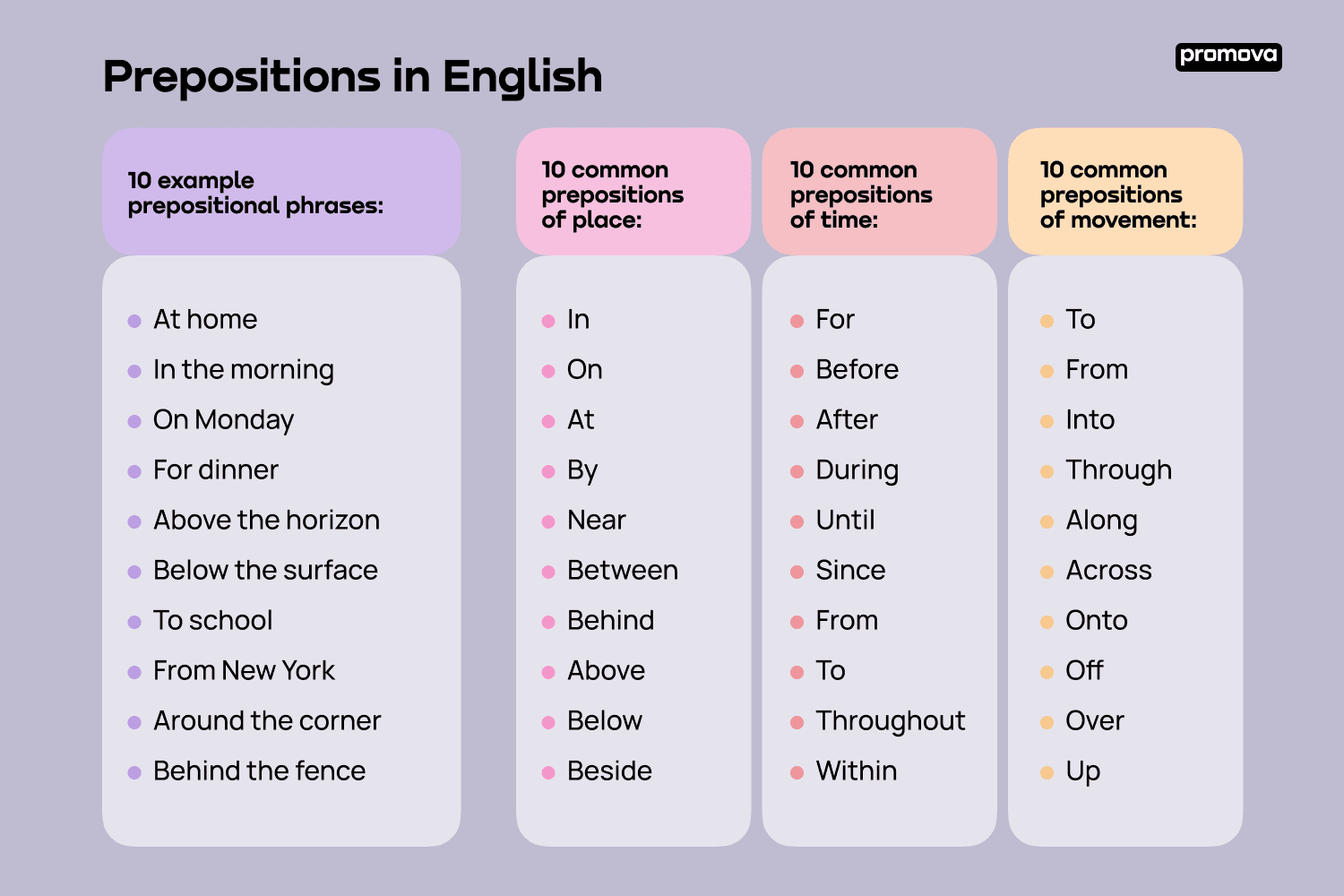
For example, the preposition “in“ in the sentence “I’m in the store” expresses the relationship between the speaker and the store. Or, in the sentence “I put my book on the table”, the preposition “on“ expresses the relationship between the book and the table. In these examples, the noun or noun phrase following the preposition is called the prepositional object, which serves as the complement of the preposition and completes the prepositional phrase.
English has between 150 and 200 prepositions, but here’s a list of 25 of the most common prepositions to help you start getting familiar with them:
| Preposition in English | Example of use |
| about | We talked about the movie. |
| above | The picture is above the sofa. |
| across | She walked across the market. |
| after | We will go out after dinner. |
| against | He leaned against the wall. |
| around | We walked around the park. |
| at | She is at the door. |
| before | I eat breakfast before work. |
| behind | The coffee shop is between the bank and the bookstore. |
| below | The temperature is below zero. |
| beneath | The keys are beneath the papers. |
| beside | She sat beside her friend. |
| between | The coffee shop is between the bank and the bookstore. |
| beyond | The mountains are beyond the river. |
| but | He answered all the questions but one |
| by | She sat by the window. |
| down | She looked down at her phone. |
| during | We stayed indoors during the storm. |
| except | I like all fruits except bananas |
| for | This gift is for you. |
| from | She is from Spain. |
| in | The keys are in my bag. |
| inside | The kids are inside the house. |
| into | The cat ran into the house. |
| near | The supermarket is near my office. |
2
Recognizing Prepositions
Getting the hang of prepositions is honestly one of those game-changing moments in your English journey — like finally understanding why people say "Netflix and chill" instead of "Netflix with chill" (trust me, prepositions matter!). These little words are basically the GPS of language, showing how different parts of your sentence connect and relate to each other. Think of them as the relationship status indicators between words — they'll tell you about location, direction, or timing. You'll typically spot them hanging out at the start of prepositional phrases, which kick off with a preposition and wrap up with a noun or pronoun (that's your prepositional object, by the way). Take "The book is on the table" — here, "on" is doing the heavy lifting, creating that bridge between the book and table, giving us the complete prepositional phrase "on the table."
Here's a pro tip that'll make you feel like a grammar detective: hunt for words that answer those classic questions — "where?" for place prepositions, "when?" for time ones, and "how?" for manner prepositions. These prepositional phrases are like the Swiss Army knives of grammar — super versatile! They can work as adjectives, adding flavor to nouns (like "the sign on the wall"), or slide into adverb mode, giving verbs some extra context ("She waited by the door"). When you're listening to English conversations — whether it's your favorite podcast or that coworker who won't stop talking about their weekend — recognizing these phrases is like having subtitles for understanding. The more you practice spotting these patterns and really paying attention to how these words position themselves in sentences, the more confident you'll become at catching prepositions in the wild and using them like the English pro you're becoming.
Types of Prepositions in English and When to Use Them
In English, there are 10 main types of prepositions, each with a specific function in sentence construction. Prepositions can be categorized based on the type of relationship they express, such as time, place, and direction. They are used to indicate relationships in time, place, and direction within sentences. Prepositions also serve different grammatical functions by taking various types of complements, including adjective phrases, adverb phrases, and even other prepositional phrases. Below, we explain when to use each type, along with examples to help you understand their role better.
Prepositions of Place
Prepositions of place indicate the location of something or someone in relation to another object. Prepositions of place include under, over, inside, outside, above, and below. Common prepositions of place such as 'in', 'on', and 'at' refer to different types of locations: 'in' is used to talk about something contained, 'on' refers to a surface, and 'at' indicates a general vicinity. Prepositions can also refer to different notions of place, such as containment, surface, and vicinity.
Some examples of prepositions of place are:
- In → in the room, in the city.
- On → on the table, on the wall. 'On' is used when something is positioned on a surface, for example: The book is on the desk.
- At → at the door, at the bus stop.
- Under → under the table.
- Over → over the head.
- Above → above the clouds.
- Below → below sea level.
- Between → between two houses.
- Behind → behind the building.
- Next to → next to the supermarket.
- Opposite → The bank is opposite the post office.
Example with 'tree': The cat climbed up the tree.
Prepositions of Time
Prepositions of time indicate when something happens, happened, or will happen. Prepositions like in and at typically denote locations in space and time. Prepositions of time include at, on, and in, which are used to indicate when something happened. Specifically, 'on' is used with days, 'at' is used with specific times, and 'in' is used with months and years. Here are some examples of prepositions of time:
- In → in July, in 2024, in the morning.
- On → on Monday, on Christmas Day.
- At → at 7 PM, at midnight.
- Since → since 2015, since yesterday.
- For → for two hours, for a week.
- During → during the meeting, during summer.
- Before → before noon, before the show.
- After → after dinner, after the movie.
- By → by 10 PM, by next week.
- Until/Till → until Monday, till 5 PM.
Prepositions of Direction or Movement
Prepositions of direction, also known as prepositions of movement, describe how something or someone moves from one place to another. Some examples of direction or movement are:
- To → to the park, to the airport. Prepositions like 'to' and 'from' denote the beginning or end point of a path in space and time, with 'to' being the most common.
- Into → into the room.
- Onto → onto the table.
- From → from Spain, from home.
- Towards → towards the door.
- Through → through the tunnel.
- Along → along the river.
- Out of → out of the house.
- Over → over the bridge.
- Past → past the school.
Specific prepositions such as 'through,' 'across,' 'into,' and 'off' each have distinct meanings in describing movement patterns. For example, 'through' indicates movement inside and then out the other side, 'across' means from one side to the other, 'into' shows entering a space, and 'off' describes movement away from a surface.
Prepositions of Manner, Cause, and Purpose
These prepositions explain how something happens (manner), why it happens (cause), or for what purpose it happens (purpose). Here are some examples:
- By → by car, by email.
- With → with a pen, with a smile.
- Like → like a boss, like magic.
- Because of → because of the rain.
- Due to → due to traffic.
- For → for learning, for fun.
- Through → through effort, through practice.
- Over → crying over a movie.
- Out of → out of love, out of fear.
- From → tired from work, sick from stress.
Prepositions of Possession
Prepositions of possession indicate belonging or relationship between people, objects or concepts. These are the prepositions of possession that exist:
- Of → the door of the house.
- With → the man with the beard.
- To → the key to the car.
- By → a book by Shakespeare.
- Prepositions of Comparison and Contrast
- Prepositions of comparison and contrast indicate similarities or differences between two or more nouns. Now let's look at some examples of prepositions of comparison and contrast:
- Like → like a teacher, like her brother.
- Unlike → unlike his friend.
- As → as a leader, as a teacher.
- Than → taller than me.
- Compared to → compared to last year.
- In contrast to → in contrast to his brother.
- Different from → different from the rest.
- Similar to → similar to mine.
- Contrary to → contrary to expectations.
- As well as → as well as his sister).
Compound Prepositions
So, let's talk about compound prepositions — those little word combos that are basically the overachievers of the grammar world! Unlike your basic, no-frills prepositions like "in" or "on" (think of them as the plain vanilla of prepositions), compound prepositions are like the fancy coffee drinks with extra shots and flavor pumps. We're talking about phrases like "in front of," "on top of," and "at the bottom of" that give you way more specific details about where things are, which direction they're heading, or how they relate to each other. Take this example: "The car is in front of the house." That "in front of" is doing some serious heavy lifting, painting a crystal-clear picture of exactly where that car is chilling relative to the house.
Now, I get it — these multi-word phrases can feel a bit overwhelming at first (like trying to remember all the steps in a TikTok dance), but trust me, they're absolute game-changers for making your English sound more natural and precise. Think about phrases like "across from," "along with," and "out of." Each one serves a different purpose: "across from the store" shows direction and location, "along with her friend" indicates who's tagging along, and "out of the car" describes movement. When you start incorporating compound prepositions into your speaking and writing, you'll notice your sentences become way more descriptive and your communication hits different — whether you're crafting the perfect email or just having a casual conversation. It's like upgrading from basic to premium, and honestly, your future self will thank you for it!
Preposition Grammar in English
Prepositions follow specific grammatical rules that determine their correct usage in a sentence. In respect of these rules, prepositions are categorized by the types of complements they can take, and their relationship with those complements. Prepositional phrases consist of a preposition followed by a noun or pronoun, or more generally, a noun phrase. These prepositional phrases can function in different parts of the sentence, such as modifiers, adjuncts, complements, and even as the subject of a clause. Additionally, prepositional phrases can be modified by adverb phrases, noun phrases, or other prepositional phrases to clarify or specify their spatial, temporal, or directional meanings. Understanding these rules will help you construct more precise and natural sentences in English.
Key Rules for Using Prepositions
1. Prepositions always have an object: The object of a preposition is the noun, pronoun, gerund, infinitive, or phrase that follows it. Prepositions can never be used alone; they must always be followed by nouns or pronouns to form prepositional phrases. Sometimes, prepositional phrases at the beginning of a sentence can be mistaken for the subject, but the subject is never part of the prepositional phrase. Misidentifying words that are part of a prepositional phrase as the subject or verb can cause subject-verb agreement problems.
- She is in the house. → “House” is the object of the preposition “in”.
- He is good at swimming. → “Swimming” is the object of the preposition “at”.
2. Prepositions are followed by nouns or pronouns: They can also be followed by gerunds, infinitives, or complete phrases.
- “She apologized for being late.”
- “They are interested in learning English.”
3. Prepositions are never used with auxiliary verbs: You cannot place a preposition directly after auxiliary verbs like “do” or “have”.
- Incorrect: *“*I have in finished my work.”
- Correct: “I have finished my work.”
4. Prepositional phrases should not start with a pronoun: Unless the pronoun refers to something previously mentioned, avoid starting a sentence with a preposition followed by a pronoun.
- Incorrect: “With him I went to the party.”
- Correct: “I went to the party with him.“
5. The order of the preposition and its object can change the meaning of a sentence: The placement of a preposition and its object can completely change the meaning of a sentence.
- “The dog ran to the bone.”
- “The dog ran the bone to the yard.”
Prepositional Phrases
Prepositional phrases are groups of words that begin with a preposition and end with a noun or pronoun, which is called the object of the preposition. In other words, prepositional phrases consist of a preposition followed by a noun or pronoun. Prepositions can also form phrases with adjectives to create connotations, express emotions, or specify actions, making language more precise and expressive. There are different types of prepositional phrases, each serving a specific function in a sentence.
Types of Prepositional Phrases with Examples
Prepositional phrases frequently function as modifiers or adjuncts in sentences, providing additional information about place, time, cause, or manner. The following examples illustrate how these grammatical structures are used in English:
1. Prepositional phrases of place: They tell us where something happens. For example:
- At night
- In July
- Before sunset
- After school
During the meeting
2. Prepositional phrases of time: They tell us when something happens. For example:
- Toward the exit
- Onto the stage
- Into the room
- Out of the car
- Through the tunnel
3. Prepositional phrases of cause/motive: They explain the reason for something. For example:
- Because of the rain
- Due to illness
- For this reason
- Thanks to your help
- On account of the traffic
4. Prepositional phrases of manner: They tell us how something is done. For example:
- With a smile
- By mistake
- In a hurry
- Without hesitation
- Like a pro
Fronting and Stranding
Let's talk about two grammar moves that can totally level up your English game: fronting and stranding! These are basically two different ways to handle prepositions in your sentences, and honestly, once you get the hang of them, you'll sound way more natural and confident.
Fronting is when you move that prepositional phrase right to the front of your sentence — think of it as the grammar equivalent of putting your best outfit first in your Instagram carousel. It's all about making a statement! Take "With whom did you go to the movies?" where "with whom" gets the spotlight at the beginning. This construction is super common in formal writing or when you want to sound a bit more polished — like when you're writing that important email to your professor or boss.
Stranding, on the flip side, is when you just let that preposition chill at the end of your sentence — and tbh, this is probably how you naturally speak already! Like when you ask "Who did you go to the movies with?" See how "with" is just hanging out at the end? This feels way more natural in everyday convos and casual texting. The cool thing is, both styles are totally correct — it's all about reading the room and matching your vibe to the situation.
I get it — this stuff can feel a bit overwhelming because English loves to break its own rules, and what works in other languages might not fly here. But here's the thing: once you start noticing these patterns, you'll see them everywhere! Compare "To whom should I send the letter?" (fronting vibes) with "Who should I send the letter to?" (stranding energy), or "On what did you step?" versus "What did you step on?" Getting comfortable with both styles is like having two different outfits in your language wardrobe — you can switch between formal and casual depending on what the moment calls for. Trust me, mastering this will have you sounding like a total pro whether you're chatting with friends or crushing that presentation!
Common Preposition Mistakes in English
Prepositions in English can be tricky because they don’t always have a direct translation in other languages. Additionally, their usage varies depending on the context. Using the wrong preposition can lead to incorrect sentences, such as 'He arrived to China at May 6th.' The correct form is 'He arrived in China on May 6th.' Another common error involves the verb 'emphasized.' Many learners mistakenly say 'emphasized on' when the correct form is simply 'emphasized,' as in 'We emphasized the importance of following directions.' Errors with prepositions can also happen when prepositions are deleted or added unnecessarily. Changing a preposition can drastically alter a sentence's intent by shifting the relationship between objects or the nature of an action. Below, we’ll review some of the most common preposition mistakes that learners make and how to correct them.
Incorrect Use of "in", "on", and "at" for Place and Time
It's important not to confuse "in", "on", and "at" when talking about location or time. Here are some basic examples to help reinforce these rules:
| Incorrect | Correct | Explanation |
| I was at the park yesterday. | I was in the park yesterday. | "in" for enclosed spaces or large areas. |
| We have a meeting in Monday. | We have a meeting on Monday. | "on" for days and dates. |
| She was born on 1989. | She was born in 1989. | "in" for years and long time periods. |
| The keys are in the table. | The keys are on the table. | Use "on" for surfaces. |
Incorrect Use of "for" and "since"
Avoid using "for" instead of "since" and vice versa when talking about time.
| Incorrect | Correct | Explanation |
| I have lived here since five years. | I have lived here for five years. | "for" with periods of time. |
| She has been here for Monday. | She has been here since Monday. | "since" with specific points in time. |
Incorrect Use of "by" and "with"
"By" and "with" are not interchangeable when talking about means or tools, as they can change the meaning of the sentence completely.
| Incorrect | Correct | Explanation |
| The book was written with L. Frank Baum | The book was written by L. Frank Baum | "by" for authorship. |
| I cut the paper by scissors. | I cut the paper with scissors. | "with" for the instrument used. |
Incorrect Use of "to" and "for"
Do not confuse "to" and "for" when talking about purpose or recipient. These examples will show the difference:
| Incorrect | Correct | Explanation |
| This gift is to you. | This gift is for you. | "for" when something is intended for someone. |
| I explained the rules for him. | I explained the rules to him. | "to" when transferring information. |
Unnecessary Use of Prepositions
Sometimes, prepositions are not needed, so it's best to avoid using them unnecessarily. These examples will show how:
| Incorrect | Correct | Explanation |
| Where are you at? | Where are you? | "At" is unnecessary. |
| She married with him. | She married him. | "With" is unnecessary. |
| Let's discuss about the plan. | Let's discuss the plan. | "About" is unnecessary. |
Incorrect Use of "in", "into", and "inside"
Another common mistake is confusing "in", "into", and "inside" when talking about movement and location. These examples will help you understand the difference:
| Incorrect | Correct | Explanation |
| She walked in the room. | She walked into the room. | "Into" indicates movement. |
| The keys are into the drawer. | The keys are inside the drawer. | "Inside" indicates location. |
Incorrect Use of "between" and "among"
Make sure not to use "between" instead of "among", and vice versa, to keep your sentences correct.
| Incorrect | Correct | Explanation |
| The money was divided among two people. | The money was divided between two people. | "between" with two elements. |
| The decision was made between the group. | The decision was made among the group. | "among" for more than two elements. |
Incorrect Use of "above" and "over"
Another pair of prepositions to avoid confusing is "above" and "over" when talking about position.
| Incorrect | Correct | Explanation |
| The clouds are over the mountains. | The clouds are above the mountains. | "Above" indicates a higher position without contact. |
| He put a blanket above the baby. | He put a blanket over the baby. | "Over" indicates full coverage. |
Incorrect Use of "on time" and "in time"
It's important not to confuse "on time" and "in time" when talking about punctuality, as their meanings are different.
| Incorrect | Correct | Explanation |
| He arrived in time for the meeting. | He arrived on time for the meeting. | "On time" means punctual. |
| I got home on time to watch the movie. | I got home in time to watch the movie. | "In time" means just in time. |
Tip from the author: If you’re unsure which preposition to use, ask yourself one simple question: Am I talking about time, place, movement, or reason? This shortcut helps you choose correctly most of the time.
Prepositions are an essential part of English grammar and are used to express relationships between two words or phrases. They can indicate time, location, direction, and establish other connections within a sentence.
Additionally, prepositions can form prepositional phrases, which include a preposition followed by a noun or pronoun to provide additional information.
We hope that the rules and explanations shared throughout this guide help you build a strong foundation to avoid common mistakes and use English prepositions with greater accuracy as you learn English online step by step.
With enough practice, prepositions will become more natural and automatic, allowing you to express yourself in English fluently and confidently.
Why Prepositions in English Feel So Difficult
Prepositions in English often confuse learners because they don’t always follow logical rules. There is also confusion in distinguishing prepositions from other parts of speech, such as adverbs, due to overlapping forms and functions. A single preposition can have multiple meanings or senses depending on context, and different languages use prepositions in completely different ways. This is why translating prepositions word for word rarely works.
The good news is that prepositions become easier once you stop memorizing them in isolation and start learning them in real sentences and patterns. Seeing how native speakers use prepositions repeatedly helps your brain recognize what “sounds right” over time.
Do Native Speakers Always Follow Preposition Rules?
Interestingly, native speakers don’t think about preposition rules at all — they rely on habit. That’s why phrases like on time, at work, or in the morning feel natural to them. For learners, the goal isn’t perfection but clarity and consistency.
Mistakes with prepositions usually don’t block understanding, but using the correct one makes your English sound smoother, more confident, and more natural.
Summary
Prepositions are an essential part of English grammar and are used to express relationships between two words or phrases. They can indicate time, location, direction, and establish other connections within a sentence.
Additionally, prepositions can form prepositional phrases, which include a preposition followed by a noun or pronoun to provide additional information.
We hope that the rules and explanations shared throughout this guide help you build a strong foundation to avoid common mistakes and use English prepositions with greater accuracy.
With enough practice, prepositions will become more natural and automatic, allowing you to express yourself in English fluently and confidently.

Comments