Korean Text Slang: Slangin' and Bangin' in the Wild World of Korean Text Talk

Contents
Key takeaways
- Korean text slang is based on consonants, sounds, and phonetic shortcuts.
- Most slang is used only in casual online communication.
- Laughing symbols and emoticons add tone and emotion to messages.
- Many slang terms come from English or playful sound imitation.
- Understanding Korean internet slang helps you read real-life messages more easily.
- Despite the modest and respectful culture of Korea, people there still know how to have fun.
And one of the most exciting features of the language, especially popular among youngsters, is the Korean text slang. There are tons of expressions, words, abbreviations, emoticons, and other interesting things native speakers use when communicating online.
Today, we are going to explore the most common ones and provide you with the ultimate guide to Korean text slang.
Introduction to Korean Slang
Want to truly vibe with your Korean friends and sound like you actually belong in those group chats? Then Korean slang is your golden ticket! These playful expressions are literally everywhere — woven through everyday convos, sprinkled across your favorite K-dramas, and dropping beats in K-pop lyrics. Korean slang gives the language its spark and personality, letting you express humor, emotions, and that authentic you-ness that formal textbook Korean just can't capture. Trust me, it's like the difference between wearing a stuffy uniform and your favorite comfy outfit.
For us language learners, picking up essentials like ㅋㅋ (basically Korea's version of "lol") or ㅎㅎㅎ (their way of saying "hahaha") is honestly a total game-changer. These little gems don't just help you decode what's happening in those lightning-fast group chats or trending social media posts — they make your own messages sound natural and effortlessly cool. Korean texting slang is woven into the cultural DNA, and mastering these expressions will help you break the ice with new friends, stay on top of the latest trends, and genuinely fall in love with your Korean learning journey.
Whether you're binge-watching the latest K-drama, sliding into Korean DMs, or just exploring this beautiful language for fun, learning slang opens up a whole new world of authentic connections and genuine laughs. So if you're ready to level up your Korean game and dive headfirst into real, unfiltered conversations, it's time to add some serious slang power to your vocabulary arsenal!
Korean Texting Basics
Okay, can we talk about how absolutely wild Korean texting slang is? It's like stepping into this whole digital universe where creativity meets convenience, and honestly, it's kind of addictive once you get the hang of it. If you're ready to dive into the Korean texting game, you'll want to get cozy with Hangul first — trust me on this one. Korean speakers have this genius way of creating shortcuts by grabbing the first consonants of each syllable in a phrase, and suddenly you're texting at lightning speed while looking like you totally know what you're doing.
Now, here's where things get really interesting — Konglish is everywhere, and I mean everywhere. Picture this: you're scrolling through Korean texts and boom, there's English just casually mixed in, creating these hilarious combinations that'll probably make your brain do a little flip at first. But stick with it, because once you start recognizing these transliterated English words or those super compact Korean slang terms that pack a whole mood into just two characters, you'll feel like you've unlocked a secret level of communication. It's honestly pretty satisfying.
And can we please appreciate Korean emoticons for a second? They're absolutely iconic. When you see ㅠㅠ (basically tears streaming down someone's face) or ㅇㅁㅇ (that perfect shocked expression), you know exactly what vibe they're going for — no translation needed. These little symbols add so much personality to every single message, whether you're expressing pure excitement or that specific type of disappointment that only a Korean emoticon can capture. Learning these texting basics is like getting your passport to Korean group chats and internet culture, and honestly? Your messages are about to get way more fun, cute, and genuinely hilarious. So come on — let's jump into this amazing world of Korean texting slang and start communicating like you've been doing this forever!
Korean Internet Slang: Deep Dive Into the Most Common Phrases
Korean slang is a bit like English slang; it uses a lot of short forms, abbreviations, and borrowed words. But it also has many unique phrases that are very different. In fact, common Korean slang and new Korean slang are constantly evolving, especially among younger generations and on social media. Understanding Korean slang terms is key to sounding natural and engaging with contemporary Korean culture.
Let’s look at some fun Korean text slang you can use to make your online chats more exciting! Many Korean slang terms are created by abbreviating longer phrases, often by taking the first syllable or consonant of each word. This results in shortened words or shortened phrases that are quick and easy to type. Korean text slang often consists of these shortened versions, and the use of initial consonants as abbreviations is very common.
- ㅇㅋ – Okay.
This is a Korean word and a slang means of saying “okay” or “ok,” typically used when agreeing with someone. For example:
오늘 만나서 놀아요! ㅇㅋ? (Let’s hang out today! Ok?)
- ㄴㄴ – No-no.
This korean expression is a transliteration of the English “no-no,” and it literally means strong disagreement. For example:
ㄴㄴ, 내일은 못 놀아요. (No-no, I can’t hang out tomorrow.)
- ㅇㅇ – Yes.
This is a shortened word formed by taking the first consonant of each syllable in 응 (eung), which means “yes.” It has the same meaning as 응 and is used in casual and relaxed online conversations. For example:
ㅇㅇㅋㅋ. (Yes, LOL.)
- ㄱㄱ – Let’s go.
This is a shortened phrase and a transliteration from English; it literally means “go-go.” The english equivalent is “let’s go.” For example:
출발할 준비 됐어? ㄱㄱ! (Ready to hit the road? Let’s go.)
- ㄱㅅ – Thanks.
This is a korean slang word describes a casual way to express gratitude in Korean, used in informal conversations. It is a shortened word formed from the initial consonants of 감사 (gamsa). For example:
선물 ㄱㅅ (Thanks for the gift.)
- ㅉㅉ – Tsk-tsk.
This is a korean expression used to show frustration or annoyance. It is used to describe disappointment, like the sound your teacher made when you were late for class. For example:
왜 항상 늦어? ㅉㅉ. (Why are you always late? Tsk-tsk.)
- ㅁㄹ – IDK.
This is a shortened word for 몰라 (molla), which literally means “don’t know.” It has the same meaning as IDK in English. For example:
ㅁㄹ 무슨 말씀이세요. (IDK what you are talking about.)
- ㅇㅈ? – Right?
This korean slang term is used in text messages when seeking approval or agreement from someone. For example:
저 드레스 잘 어울려요. ㅇㅈ? (I look good in that dress. Right?)
- ㅈㅅ – Sorry.
This is a very informal way to apologize, used only among peers in casual settings. The word means “sorry” and is a shortened word from 죄송 (joesong). For example:
늦었어, ㅈㅅ. (I’m late, sorry.)
- ㅇㄷ – Where are you?
This korean word is used to either ask where the receiver of the message is or to find out where something is in general. For example:
ㅇㄷ? 거의 도착했어요. (Where are you? I’m almost there.)
- ㅇㅋㄷㅋ – Okey-dokey.
You already know ㅋ meaning in Korean. However, in this slang phrase, alongside other symbols, it is used to agree to something. It is another transliteration of the English expression. For example:
ㅇㅋㄷㅋ, 모르겠어요. (Okey-dokey, I’ll see you there.)
7
- ㅊㅋ – Congrats.
This is a shortened form of 축하해요 (chukhahaeyo), and the word means “congratulations.” It is often paired with an exclamation mark (!) to show excitement. For example:
시험 잘 봤어요. ㅊㅋ! (Good job on the exam. Congrats!)
- ㅎㅈㅇㅇ – TL;DR.
In English, we use the slang phrase TL;DR (Too Long; Didn’t Read) to respond to a long, annoying message. ㅎㅈㅇㅇ is a korean expression and a one line summary, serving the same purpose. For example:
ㅎㅈㅇㅇㅈㅅ. (TL;DR, sorry.)
- ㄹㄷ – Are you ready?
This is yet another transliteration in our list. In this case, it is used to ask whether your interlocutor is ready to do something. For example:
- 차가 아래층에서 기다리고 있습니다. ㄹㄷ? (The car is waiting downstairs. Are you ready?)
- ㅅㅇㅊㅋ – Happy Birthday.
This is a very short and informal way to greet someone on their birthday, formed by abbreviating the phrase 생일 축하해요. For example:
ㅅㅇㅊㅋ! 널 사랑해. (Happy birthday! I love you.)
- ㅈㄱ (jg) – Please. (Short for 제발)
Often used when someone is begging or pleading for something in a playful or dramatic way. For example:
숙제 안 낸 거 비밀로 해줘 ㅈㄱ… (Please don’t tell anyone I didn’t do the homework…)
- ㅇㅈ (yj) – Acknowledged or “I agree.” (Stands for 인정)
Used to show agreement or say “true” in response to someone’s comment. For example:
그 영화 진짜 명작이야 ㅇㅈ (That movie is a masterpiece, totally agree).
- ㅎㄷㄷ (hdd) – Shaking/trembling. (Represents 후덜덜)
This korean slang word describes something intense, scary, or overwhelming, and can also refer to a mental breakdown in stressful situations. For example:
저 시험 난이도 뭐야… ㅎㄷㄷ (What was that exam?! So hard…)
- ㅊㄱ (chg) – Chicken. (Short for 치킨)
A fun, casual way to refer to fried chicken, often in group chats when suggesting food. For example:
오늘 저녁에 ㅊㄱ 어때? (How about chicken for dinner tonight?)
- ㅎㅇ – Hi.
This is only two characters and is a concise, informal greeting or salutation, often used among friends and family for its brevity and ease. For example:
ㅎㅇ! 잘 지냈어? (Hi! How have you been?)
- ㅗ – Middle finger emoticon.
This emoticon visually resembles a middle finger and is used to convey annoyance or insult in a subtle or humorous way.
ㄷㄷ – Used to express fear or shock.
This is a shortened word mimicking a shivering sound, used to express fear or surprise in reaction to something shocking.
- 8282 – Hurry up.
This is a playful technique using korean numbers (팔이팔이, pronounced “pal-i pal-i”) to sound like 빨리빨리 (ppalli ppalli), which means “hurry hurry.” It reflects the fast-paced culture and is used to urge someone to act quickly.
- 알바 (alba) – Part-time job.
This korean word comes from the german word “arbeit,” meaning “work.” It is used to describe part-time jobs, especially among students.
Learning these small codes can help you connect with Korean speakers and feel more confident using everyday digital language. Korean slang often reflects the influence of digital communication and social media, and new slang terms frequently emerge from youth culture, particularly in response to trends in music and entertainment.
Other Korean slang terms you should know:
- 남친 (namchin): Slang for boyfriend, derived from 남자 친구 (namja chingu). Phrase refers to a romantic partner.
- 여친 (yeochin): Slang for girlfriend, derived from 여자 친구 (yeoja chingu). Phrase refers to a romantic partner.
- 남사친 (namsachin): Means male friend who is just a friend, not a boyfriend. Used to describe a platonic male friend.
- 여사친 (yeosachin): Means female friend who is just a friend, not a girlfriend. Used to describe a platonic female friend.
- 베프 (bepeu): Shortened word for best friend, from 베스트 프렌드 (beseuteu peurendeu).
- 엄친아 (eomchina): Used to describe a “perfect son” (엄마 친구 아들, mom’s friend’s son), often in the context of parental comparisons.
- 엄친딸 (eomchinttal): Used to describe a “perfect daughter” (엄마 친구 딸, mom’s friend’s daughter).
- 모쏠 (mossol): Short for 모태 솔로 (motae solo), literally means “single since mother’s womb.” Used to describe someone who has never dated.
- 치맥 (chimaek): Combination of chicken and beer, a popular food pairing in Korea.
- 썸 타다 (sseom tada): Used to describe the ambiguous phase before a relationship becomes official.
- 대박 (daebak): Korean slang word describes something awesome or a jackpot moment.
- 헐 (heol): Korean expression used to show shock or surprise, similar to OMG.
- 노잼 (nojaem): Used to describe something boring or not fun.
- 꿀잼 (kkuljaem): Used to describe something super fun or entertaining.
Korean slang provides insight into modern social dynamics and cultural expectations. Using numbers that sound similar to words is a common playful technique in Korean slang. Korean slang evolves rapidly, often outpacing formal language education, and understanding these terms is essential for engaging with contemporary Korean media and culture.
One more cultural tip: In Korean chats, you might come across something called aegyo (애교), a cute and endearing way of speaking or acting. People use aegyo in texting with baby-like words, cute emojis, and a playful tone. Aegyo often includes using a baby voice—a texting style that uses elongated vowels, playful modifications, and characters like ㅇ or ~ to make the sentence sound more adorable. It’s common between friends and couples and helps messages feel warm and friendly.
Korean Laughing Text Slang
Just like English speakers use “lol” or “haha” in chats, Korean speakers have their own fun ways to show laughter in text. These Korean slang expressions and Korean slang terms are commonly used to express amusement in digital conversations. These Korean laughing text slang expressions help add tone and personality to digital conversations, making them feel more natural and playful.
- ㅋㅋ – LOL.
This abbreviation represents laughter, similar to LOL in English. It is a shortened word for laughter and is widely used in texting to signify amusement. You can use it as many times as you want, depending on the ridiculousness level of the joke. For example:
그 짤 너무 웃겨 ㅋㅋ. (That line is so funny, LOL.)
- ㅎㅎㅎ – Hahaha.
This slang expression denotes a light chuckle or a brief burst of laughter. It is not as strong as the previous one but can still be used to express a laugh. You can see an example in this Korean laughing text:
너무 귀여워 ㅎㅎㅎ. (So cute, hahaha.)
- 푸하하 – Puhaha.
This one expresses big, burst-out laughing, similar to “LOL” or “LMAO.” It’s used when something is truly hilarious or shocking in a funny way. For example:
푸하하 진짜 너무 웃겨! (LOL that’s seriously hilarious!).
- ㅋㅋㅋㅅㅂ – Laughing but shocked.
This slang expression combines laughter with surprise or shock. It is used when something is funny but also unexpected, awkward, or slightly unbelievable. The laughter feels emotional rather than relaxed. For example:
이게 진짜라고? ㅋㅋㅋㅅㅂ. (Is this for real? LOL, I’m shocked.)
- ㅎㅎㅋㅋ – Polite laughter mixed with amusement.
This expression shows a soft, polite laugh with a hint of real amusement. It is often used to keep the tone friendly, slightly awkward, or respectful, especially in group chats or less close conversations. For example:
그 말 좀 웃기네 ㅎㅎㅋㅋ. (That’s kind of funny, haha.)
- ㅋㅋ… – Awkward or forced laugh.
This slang form of laughter is used when something is not actually funny, or when the sender feels awkward, uncomfortable, or unsure how to respond. It often signals politeness rather than real humor. For example:
- 아… 그렇군요 ㅋㅋ…. (Oh… I see… haha.)
These simple symbols carry tone, mood, and emotion, so don’t be afraid to sprinkle these Korean slang terms into your texts and join the fun!
Korean Emoji Text: Emoticons in Communication
In addition to using slang phrases when texting, Koreans also like emoticons – faces showcasing various emotions created by different keyboard symbols. These are the so-called ancestors of modern emojis, still very popular in Korea. Many korean slang expressions and korean slang terms include emoticons that visually represent emotions or reactions, such as ㅠㅠ for crying eyes or OTL for defeat. Let’s explore the list of exciting emoticons to use in your text messages.
- ^o^, ^_^, ^-^ – similar to ^^ meaning in text Korean, these emoticons represent smiling faces;
- ㅜㅜ, ㅠㅠ, T.T, ㅠ.ㅠ – these are different variations of sad/crying faces;
- ^.~, ^3^, ♡.♡, ^.^ – those are flirty faces;
- ㅇㅅㅇ – this is a sweet, cute face;
- ㅇㅁㅇ – this is a shocked/surprised face;
- ;ㅅ; – this one, similar to ㅠ meaning, is also a crying face;
- OTL/ㅇㅈㄴ – this one represents the person kneeling, typically showcasing disappointment or misery.
- ಠ_ಠ – judging or unimpressed
- (╯°□°)╯︵ ┻━┻ – flipping table (rage)
- (´• ω •`) ♡ – shy affection
- (ಥ﹏ಥ) – emotional crying
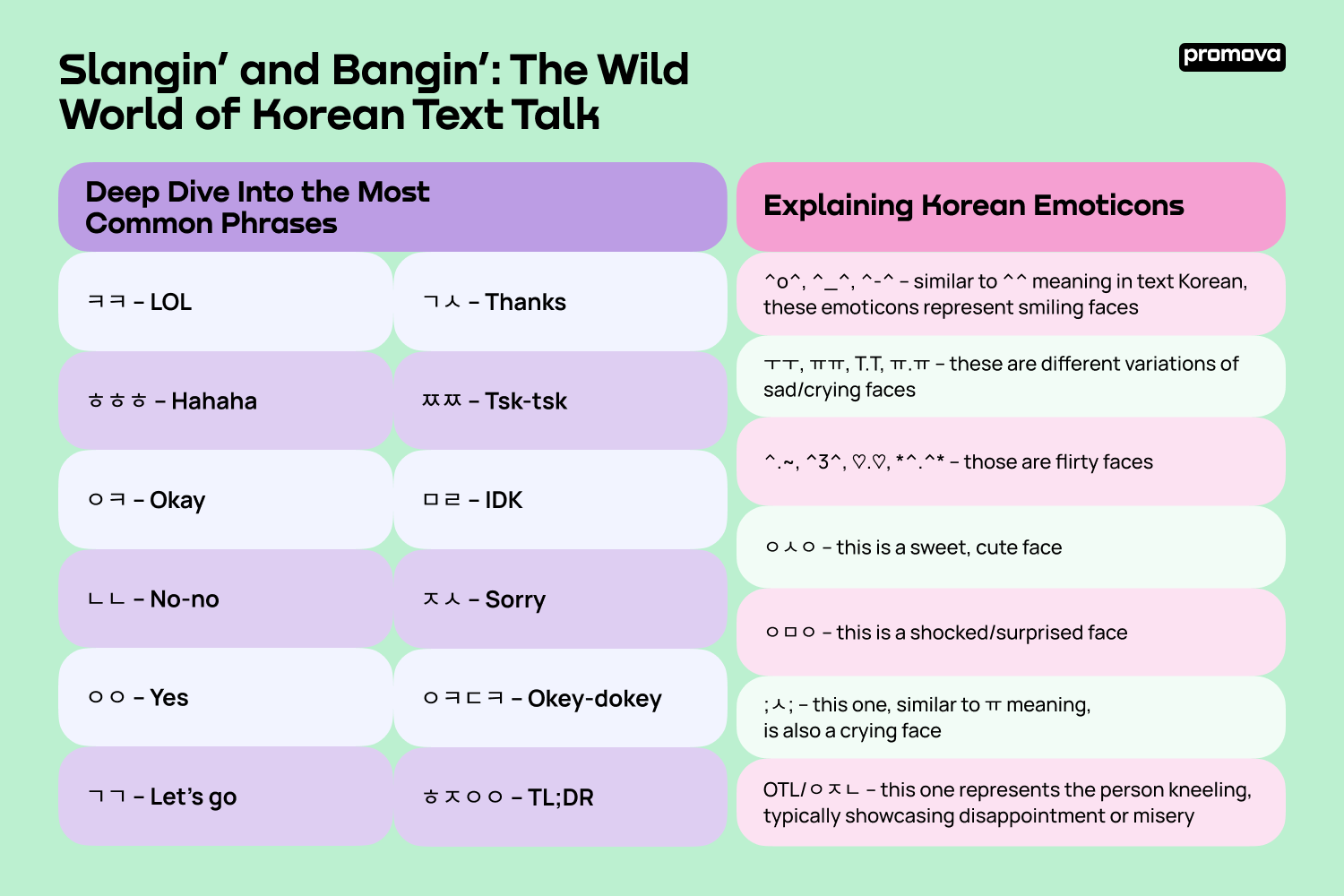
But of course, the list doesn’t end here; a day won’t be enough to mention all existing Korean emoticons, as there are thousands of them. And it is actually great because you can find numerous cute faces to express your emotions when texting as clearly as possible.
Exciting Korean Texting Slang with Numbers
Another thing Korean and English slang have in common is the usage of numbers. However, there is a difference at the same time. In English, we often use numbers with letters to shorten words (like 4ever, w8, lu2, etc.). Koreans do it, too, but in some cases, they take this concept to a whole new level, replacing words and even phrases with numbers. In Korean slang, 'korean numbers' are often used as a 'shortened phrase' or abbreviation, and using numbers that sound similar to words is a common playful technique in Korean slang expressions. Here is the list of the most common examples.
- 8282 – Hurry up.
The first term represents 빠빠롭게 [pɑpɑɾopk*ɛ], which means “quickly” or “hurry up” in Korean. Basically, those numbers read aloud sound almost identical to this phrase.
- 091012 – Study hard.
This Korean abbreviation is used when you need to tell someone to study hard. The concept here is the same as in the previous example; the pronunciation of the numbers is similar to that of the original phrase.
- 1004 – Angel.
This phrase is pronounced as 천사 [tɕʰʌnsɑ], which means “angel” in Korean when read phonetically. It is often used to compliment someone, indicating they are like an angel.
- 감4 – Thank you.
This is an informal and shortened way of expressing gratitude, similar to “thanks.”
- 하2루 – Hi.
You can send this phrase in a text message to greet someone, as this expression simply means “hi.” It combines transliteration of an English word and abbreviation with numbers similar in pronunciation to its meaning.
- 700 – Cute.
The last number on this list is used as a slang term to describe someone adorable. Those numbers represent ㄱㅇㅇ – an abbreviation for 귀여워 [kwijʌwʌ], which also means cute.
- 바2 – Bye.
This expression is a perfect example of transliteration. When you read it aloud, you’ll hear “baee,” which is similar to the most typical English farewell. As a result, you receive a perfect way to say goodbye to someone.
- 222 – Same here / Me too.
This number slang is used to show agreement or say that you feel the same way as the other person. It works like “me too” in English and is common in casual chats and group conversations. The repetition of the number makes it feel quick and informal.
- 404 – Not found.
This expression comes from the internet error message “404 not found.” In Korean texting, it is used when someone is being ignored, unavailable, or not responding. It can also jokingly suggest that a person’s mind is “not working” at the moment.
- 1010235 – Love you forever.
This number-based slang is a phonetic play on a Korean phrase that sounds similar when read aloud. It is used to express long-lasting affection or love in a playful, informal way, especially in messages between close friends or romantic partners.
Tip from the author: If you see a Korean message full of consonants and numbers, don’t panic. Read it out loud — most Korean text slang makes sense once you hear how it sounds.
Why Korean Text Slang Looks So Different from Spoken Korean
Korean texting slang often surprises learners because it looks very different from standard spoken Korean. Many expressions are built from consonants, numbers, or sounds rather than full words. This makes messages shorter, faster, and better suited for quick chats.
Another reason is efficiency. Typing full sentences on a phone takes time, so Korean speakers simplify language as much as possible while still keeping meaning and emotion. Once you understand the logic behind these shortcuts, Korean text slang becomes much easier to read and use.
When Korean Text Slang Is Appropriate — and When It’s Not
Korean internet slang is meant for informal situations only. It’s commonly used with friends, classmates, family members, and in casual online spaces like chats, comments, or social media posts. Using it in the right context helps you sound natural and friendly.
However, this type of slang should be avoided in formal writing, work messages, or communication with people you don’t know well. Knowing when not to use slang is just as important as knowing the slang itself, especially in a culture that values respect and social boundaries.
How Korean Text Slang Reflects Modern Korean Culture
Text slang in Korean shows how playful, creative, and expressive modern communication has become. Laughing symbols, cute emoticons, and number-based phrases all help add emotion to messages that might otherwise feel flat.
This style of communication also reflects how language evolves online. Korean text slang changes quickly, influenced by trends, memes, and pop culture. Learning it gives you insight not only into the language, but also into how people connect and express themselves in everyday digital life.
Easy Tips for Mastering Korean Texting Slang
Learning slang in every language is an exciting way to immerse yourself in the intricacies of the tongue and reach fluency while having fun. However, conquering these nuances might be quite a challenging task. To better understand and master this topic, keep in mind these simple yet helpful tips.
- Learn the basics. Before mastering more difficult expressions, memorize the most widespread words and phrases, like the ones representing laughter or used for showcasing other emotions. It is an excellent start to learning slang.
- Stay updated with trends. Follow Korean social media influencers, read blogs, and watch popular videos. The more you immerse yourself in modern culture, the easier it will become to understand what’s trendy and what slang expressions are the most used in this period of time.
- Learn Korean slang through real content. The best way to learn Korean slang is by exposing yourself to authentic materials such as K-dramas, social media, and online videos. This helps you recognize and use slang naturally in context. Consider using digital tools like browser extensions for real-time word lookup and context retention to make your learning more immersive.
- Find a texting buddy. Having a language-learning friend is a great way to master the tongue from the point of view of a native speaker. And if you communicate online using text messages, it is a great opportunity to see what slang expressions the person uses in everyday conversations.
- Understand the context. It’s crucial to know when and with whom to use Korean slang. Using slang in the wrong context can make you sound rude or disrespectful, especially in formal situations or with people you don’t know well.
- Be mindful of generational differences. Some Korean slang terms may be outdated or unfamiliar to younger speakers. Always check if a slang term is still in use or if it might sound old-fashioned.
And keep in mind the main tip – always stay open to learning. Every language is ever-evolving, and new phrases, expressions, and slang terms appear almost every week. Therefore, keep an open mind and be curious about the novelties, as it is a great way to expand your vocabulary in the most natural and pleasant way.
Exploring Korean Slang and Beyond with Promova
Learning Korean texting slang is impossible without having a good understanding of grammar and rules. It is vital to learn all the basics before moving to more unique studies. And mastering all these skills will be much easier with Promova – your one-stop solution for fluency. The installation of the Promova app on your iOS or Android, you can build a strong foundation and explore real-life language through themed learning paths, including a dedicated slang course focused on modern, everyday communication.
- learn Korean, German, Spanish, English, French, and other languages;
- practice anywhere and anytime, seamlessly integrating your learning into your busy schedule;
- enjoy engaging and captivating interactive lessons created by language professionals;
- Practice bite-sized learning, focusing only on those things that are important.
Using the Promova app is a great way to master a language, and you only need to invest a few minutes a day. However, keep in mind that the final results solely depend on your efforts.
Remember to practice and improve your speaking, reading, listening, and writing skills; with a bit of our help, you'll reach your language goals faster than you think!
Conclusion
All in all, Korean texting slang is an exciting feature of the language for many reasons. Learning it allows you to communicate in Korean more effectively and easily understand modern terms and expressions. However, it's vital to keep in mind that using slang might not always be appropriate. Avoid overusing it and/or utilizing it in formal situations.
FAQ
What does ~~~ mean in Korean text?
In Korean, "~~~" is often used to stretch the tone of a sentence. It adds emotion, such as cuteness, friendliness, or teasing, similar to when one drags out words in English (e.g., "Hellooo!" or "Nooo way!").
What does 🤌 mean in Korean text?
The 🤌 emoji is often used to express something delicious or perfect. In a Korean emoji text, it can convey strong approval, such as saying "Yummy!" or "Just right!"
What is the English equivalent of aegyo?
Aegyo is a Korean expression that refers to acting cute or charming, often accompanied by gestures or a baby-like voice. The closest English equivalent is "being adorable" or "doing cute tricks."


Comments