Spanish Alphabet Explained: Letters, Pronunciation Rules, and Key Differences from English
Contents
Key takeaways
- The modern Spanish alphabet has 27 letters.
- Spanish pronunciation is more consistent than English.
- Vowels in Spanish always have one clear sound.
- Accent marks can change both stress and meaning.
- Understanding letters early makes reading and speaking easier.
Letters are the fundament of any word, so the alphabet is a must thing to learn in any language. Spanish alphabet looks similar to English since they both evolved from Latin. However, letters in the Spanish alphabet have different pronunciations. Understanding the Spanish alphabet is the cornerstone of your journey to mastering this popular language, and in this article, you will learn the modern alphabet and key rules to use it.
Introduction to the Spanish Alphabet
So, you're diving into Spanish? Let's talk about "el alfabeto" or "el abecedario" — basically your new best friend if you want to actually sound like you know what you're doing. Here's the thing: Spanish rocks 27 letters, which is pretty much like English but with a plot twist. Meet "ñ" — that squiggly-topped letter that's basically Spanish's way of saying "we're special, and you can't have this sound." It's like the VIP letter that English wishes it had, and honestly? It's kind of iconic.
Now, here's where it gets interesting (and a little nerdy, but in a good way). Spanish is part of the Romance language family, which means it's got some serious family history — we're talking Latin roots with some Greek and Arabic influences thrown in for flavor. Over the centuries, this alphabet has been through more glow-ups than your favorite influencer, adapting to fit Spanish speakers all around the world. Look, mastering "el abecedario" isn't just about checking boxes — it's your foundation for reading, writing, and actually sounding confident when you speak. Whether you're just starting out or leveling up your skills, getting cozy with these 27 letters is going to help you connect with millions of Spanish speakers worldwide. Trust me, your future self will thank you.
Components of the Spanish Alphabet
There are 27 letters in the Spanish alphabet. Here is the actual Spanish alphabet pronunciation and letter names:
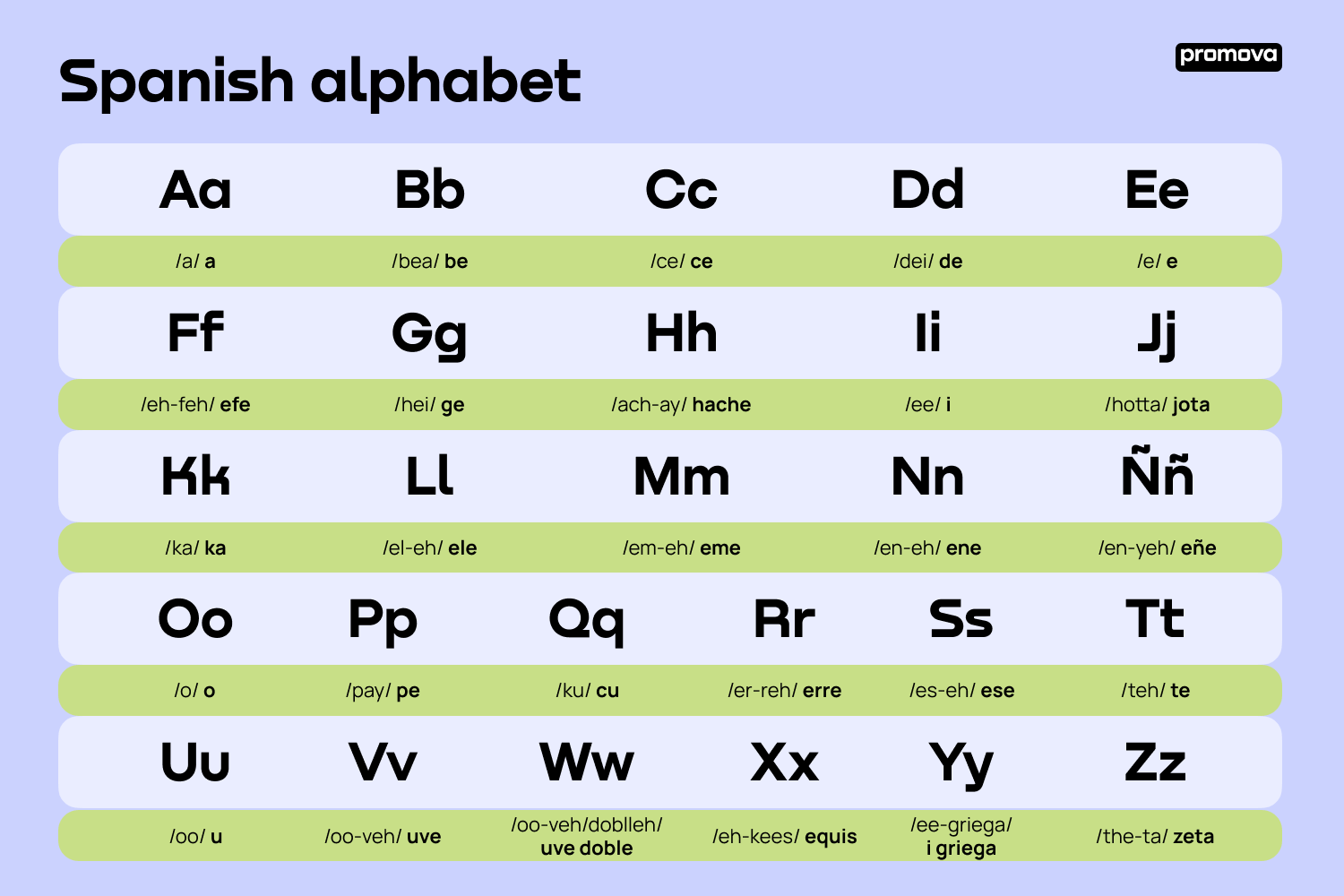
| Letter | Phonetic Transcription | Name of the letter |
| A | /a/ | a |
| B | /bea/ | be |
| C | /ce/ | ce |
| D | /dei/ | de |
| E | /e/ | e |
| F | /eh-feh/ | efe |
| G | /hei/ | ge |
| H | /ach-ay/ | hache |
| I | /ee/ | i |
| J | /hotta/ | jota |
| K | /ka/ | ka |
| L | /el-eh/ | ele |
| M | /em-eh/ | eme |
| N | /en-eh/ | ene |
| Ñ | /en-yeh/ | eñe |
| O | /o/ | o |
| P | /pay/ | pe |
| Q | /ku/ | cu |
| R | /er-reh/ | erre |
| S | /es-eh/ | ese |
| T | /teh/ | te |
| U | /oo/ | u |
| V | /oo-veh/ | uve |
| W | /oo-veh/doblleh/ | uve doble |
| X | /eh-kees/ | equis |
| Y | /ee-griega/ | i griega |
| Z | /the-ta/ | zeta |
Notes:
- The names of the letters in the Spanish alphabet are always feminine, such as la eme and la hache.
- Many letters in the Spanish alphabet have names that differ significantly from their English counterparts.
- The letters 'k' and 'w' are part of the Spanish alphabet but are mainly used in loanwords and proper names of foreign origin, such as 'Kant' or 'Washington'. The letter 'w' is the least used letter in the Spanish alphabet.
- The letter 'e' is the most common letter in both English and Spanish texts.
- 'B' and 'V' are pronounced the same in most Spanish dialects, producing the same sound. The letter 'v' is also known as 've chica' or 've corta' in different regions, while 'b' is sometimes called 'be grande'. Spanish speakers do not distinguish between 'b' and 'v' in pronunciation.
- 'B' and 'C' are individual letters, and the sequence 'b c' can be important in syllabification and phonetic considerations in Spanish.
- 'Doble ele' (LL) was historically considered a separate letter and is still important in Spanish orthography, though now treated as a digraph.
- 'Ch' and 'll' were once considered separate letters but are now digraphs; this affects how words are alphabetized in dictionaries.
- 'I latina' (i) is distinguished from 'i griega' (y), reflecting their Latin and Greek origins.
- The concept of 'different letters' producing the 'same sound' is seen with 'b' and 'v', and sometimes with 'c', 's', and 'z' depending on dialect.
- Each 'single letter' in Spanish generally represents one sound, and 'one letter' can correspond to a single phoneme.
- 'Capital letter' usage in Spanish follows the same rules as in English, with origins from Latin and Greek scripts.
The Spanish alphabet includes five vowels: a, e, i, o, and u. Understanding these five vowels is crucial for correct pronunciation in Spanish.
The Ñ (pronounced “en-yeh”) is special to the Spanish alphabet, representing a unique sound not found in English. Spanish also features accents, which are essential to the language’s phonetics and grammar.
Interesting fact: The letter ñ was officially added to the Spanish alphabet in the Middle Ages and is now considered a cultural symbol of the Spanish language.
Pronunciation Guide
Pronunciation is key to Spanish fluency. Understanding how to pronounce each letter correctly will assist you in speaking and understanding Spanish.
Consonants in Spanish often sound softer or are pronounced differently compared to English. For example, the letter 'h' is always silent in Spanish and is not pronounced at all, while 'j' is pronounced like the English 'h', and 'r' can be tapped or rolled depending on its position in a word. The silent 'h' has historical origins as an aspirated sound in some dialects, and its presence in modern Spanish can sometimes be traced to foreign words or loanwords where aspiration may still be represented in spelling but not in pronunciation.
Some letters or combinations in Spanish can have two different pronunciations, such as when a word can be pronounced with either a diphthong or a hiatus, depending on regional variation or orthographic rules. Additionally, certain letters can have two sounds, especially when diacritical marks like the diaeresis (¨) are used—for example, in 'güe' or 'güi', the 'u' is pronounced, resulting in two distinct sounds.
Listening and practicing are essential to master these pronunciation differences and to become comfortable with the unique sounds of the Spanish alphabet.
Vowels: a, e, i, o, u
The Spanish alphabet includes five vowels: a, e, i, o, and u. Unlike English, Spanish vowels have only one sound each. “A” sounds like ‘ah,’ “E” sounds like ‘eh,’ “I” sounds like ‘ee,’ “O” sounds like ‘oh,’ and “U” sounds like ‘oo.’
Each Spanish word has a stressed vowel, which is the syllable you emphasize when pronouncing the word. The stressed vowel can be indicated by a written accent mark (´) placed over the vowel. The written accent mark not only shows which vowel is stressed but also helps distinguish between words that are spelled the same but have different meanings or pronunciations.
Consonants
Most consonants in Spanish have similar sounds to their English counterparts, with some exceptions. For example, “H” is always silent, “J” sounds like the ‘h’ in ‘hat,’ and “V” is pronounced the same as ‘b’ in most Spanish dialects—a fact that can be surprising for learners. The letters 'b' and 'v' are pronounced with the same sound, and Spanish speakers do not distinguish between them in speech. This is known as the 'same sound' phenomenon. The letter 'v' is often called 've chica' or 've corta' in different regions to distinguish it from 'b', which is called 'be' or 'be grande.'
Additionally, 'b' and 'c' are individual letters in the Spanish alphabet, and their classification is important for syllabification and phonetic considerations. The letter 'c' is pronounced as 'k' before 'a', 'o', and 'u', and as 's' before 'e' and 'i' in most dialects. The letter 'z' is pronounced as 's' in most of Latin America, while in Spain it is pronounced like the 'th' in 'think'.
Letter "G" With Vowels
In Spanish, the pronunciation of “g” before vowels can vary depending on the vowel that follows it. There are specific rules for how “g” is pronounced in different situations. The capital letter 'G' in Spanish, as in other Romance languages, is derived from Latin and Greek scripts, and its usage in uppercase follows standard orthographic conventions.
G + “a,” “o,” “u,” and G + “ue,” “ui”: In these cases, “g” is pronounced as a hard “g” sound, similar to the English “go” or “get.” Here are some examples:
- gato /ˈɡa.to/ - cat;
- guitarra /ɡiˈta.ra/ - guitar;
- guiso /ˈɡwi.so/ - stew;
- gusto /ˈɡus.to/ - taste.
G + “e,” “i”: In these cases, “g” is pronounced as a soft “h” sound, similar to the “h” in the English word “hello.”
- gente /ˈhɛn.te/ - people;
- girasol /ˈhi.ra.sol/ - sunflower.
In comparison, Portuguese uses the letter "g" in a similar way, but with some differences in pronunciation, especially before "e" and "i," where it can sound like the "s" in "measure." In French, the "gn" digraph is used to represent the palatal nasal sound, which is similar to the Spanish "ñ." This highlights how Romance languages like Spanish, Portuguese, and French have distinct orthographic and phonetic conventions for representing similar sounds.
Special Letter Ñ Pronunciation Rules
In Spanish alphabet, the letter “ñ” (called “eñe”) represents a unique sound that does not exist in English. The “ñ” sound is a palatal nasal, similar to the “ny” sound in the English word “canyon.” The letter 'ñ' was officially recognized as a separate letter in the Spanish alphabet in the 15th century by Antonio de Nebrija. In French and Portuguese, a similar palatal nasal sound is represented by the "gn" digraph, as in the French word "montagne" or the Portuguese word "senhor," but in Spanish, this sound is always written as "ñ." Here are some examples:
- niño /ˈni.ɲo/ - boy or child;
- mañana /ma.ˈɲa.ɲa/ - tomorrow;
- señor /se.ˈɲor/ - mister, sir;
- baño /ˈba.ɲo/ - bathroom.
When you encounter a word with “ñ,” remember to make a nasal sound while keeping the tip of your tongue against the hard palate in your mouth. With practice, you’ll be able to incorporate the “ñ” sound seamlessly in your Spanish speech.
| Letter | Usage note |
| B / V | Often pronounced the same in many regions |
| C | Soft before e and i, hard before a, o, u |
| J | Always pronounced as a strong “h” sound |
| X | Can sound like ks, s, or h depending on the word |
| Y | Functions as both a vowel and a consonant |
Reading Digraphs in Spanish
Language is dynamic, and the Spanish alphabet is no exception. In 2010, the Real Academia Española reformed the Spanish alphabet by removing the digraphs 'ch' and 'll' as separate letters, so they are no longer considered distinct letters of the alphabet. Historically, both 'ch' and 'doble ele' (ll) were treated as separate letters, each with its own place in the alphabet and unique pronunciation. Today, the letters of the alphabet are organized with these digraphs treated as letter combinations rather than separate letters, following updated Spanish orthographic rules. However, they are still used as digraphs in words.
How to pronounce ch in Spanish
In Spanish, the digraph "ch" represents a single sound, which is different from the individual sounds of "c" and "h" when they appear separately. The "ch" sound in Spanish is similar to the English "ch" in "chat" or "chocolate." Here are some examples:
- chico /ˈtʃi.ko/ - boy;
- mucho /ˈmu.tʃo/ - much, many;
- chocolate /tʃo.ko.ˈla.te/ - chocolate;
- búsqueda /buˈkes.ta/ - search.
It is important to note that the "ch" sound in Spanish is always consistent and does not change based on the surrounding letters or sounds.
How to pronounce ll in Spanish
In Spanish, the pronunciation of “ll” (also known as 'doble ele')
Differences between R and RR
For Spanish language learners, it is important to understand the pronunciation differences between "r" and "rr" since it might change the meaning of the word. Here are some examples:
- Perro /ˈper.ro/ - "dog," but Pero /ˈpe.ɾo/ - "but”;
- Rato /ˈra.to/ - "a while" or "mouse," but Raro /ˈra.ɾo/ - "strange" or "rare";
- Barro /ˈba.ro/ - "mud" or "clay," but Baro /ˈba.ɾo/ - "baron" (a noble title).
Compared to English, try to pronounce such words as "daddy" or "butter" and focus on the moves of your tongue. "R" in Spanish is very similar to soft "D" or "T" sounds in English. "RR" sounds like a rolled "R." To understand it, try to purr like a cat and notice the actions of your tongue.
Understanding Diacritical Marks
In Spanish, the emphasis typically falls on the second-to-last syllable of words. Words ending in a vowel, ‘n,’ or ‘s,’ stress the second-to-last syllable, while those ending in a consonant (except ‘n’ or ‘s’) stress the last syllable. However, a written accent mark (´) is used to indicate the stressed vowel in a word, which can override these default rules. The written accent mark not only signals which vowel is emphasized but also helps clarify pronunciation and meaning, especially in words with irregular stress patterns or to distinguish different word forms.
Additionally, Spanish uses two dots (¨), called a diaeresis, over the letter 'u' in certain words (such as "pingüino") to show that the 'u' should be pronounced. This results in two sounds, making the vowel combination (like "gue" or "gui") pronounced as separate syllables rather than a single blended sound.
Role of Acute Accent in Spanish
In Spanish, the acute accent (') is used to indicate the stress or emphasis on a particular syllable in a word.
Example: música /ˈmu.si.ka/ - here, the acute accent is used over the letter "ú" to indicate that the stress falls on the "u" syllable. The word means "music." Without the acute accent, the word would be "musica"/mu.ˈsi.ka/, and the stress would be on the second syllable.
The acute accent is a crucial element in Spanish spelling, as it helps differentiate between words that may have the same letters but different meanings and pronunciations depending on where the stress is placed.
Important note. Accents can also change the meaning of a word entirely. For example, "si" means 'if,' but "sí" means 'yes.' The acute accent (') indicates stress placement and differentiates homonyms.
The Use of Diaeresis
In Spanish, the diaeresis (¨), also known as "two dots," is used to indicate that two vowels are usually pronounced as separate syllables. It is commonly used with the letter “u” in the combinations “gue” and “gui” when the “u” is intended to be pronounced. Without the diaeresis, the “u” in these combinations would usually be silent. When you see the two dots over the "u," it signals that the "u" should be pronounced as two sounds, rather than being silent.
Example: pingüino /pin-ˈgwi-no/ - here, the diaeresis is used over the letter “u” in “güi” (gue + i) to indicate that the “u” is pronounced. The word means “penguin.”
Without the diaeresis, the word would be “pinguino”/pin-ˈgi-no/, and the “u” would be silent.
Please note that the use of the diaeresis in Spanish is relatively limited compared to other languages, and it is mainly used to distinguish the pronunciation in specific cases like the one mentioned above.
Orthographic Principles in Spanish
Here's the thing about Spanish orthography — it's actually your best friend when it comes to mastering the language! The Spanish alphabet follows some pretty logical rules that make spelling and pronunciation way more predictable than what you might be used to. Let's talk about accent marks first — those little acute accents (á, é, í, ó, ú) are like GPS for your pronunciation. They're placed over vowels to show exactly where the stress should land, and honestly? They're lifesavers for distinguishing between words that look identical but mean totally different things. It's like having a built-in cheat code for getting the pronunciation right!
Now, let's dive into some other cool features that make Spanish so beautifully systematic. You've got the dieresis (ü), which pops up over the letter "u" in combinations like "güe" or "güi." Think of it as a little reminder saying "Hey, don't forget about me!" — it tells you that the "u" actually gets pronounced instead of staying silent like it usually does. And then there's the tilde (~) sitting pretty over the "ñ," creating a completely unique sound that's nothing like a regular "n." These marks aren't just decorative — they're doing the heavy lifting to keep everything clear and organized.
Spanish also rocks some digraphs like "ch" and "ll" that represent their own distinct sounds, even though they're not considered separate letters in today's alphabet anymore. Here's what's amazing about all these orthographic rules — they're designed to help you succeed! Whether you're a Spanish speaker or someone learning the language, these principles work together like a well-organized system that actually makes sense. By getting familiar with these patterns, you'll discover that Spanish spelling is incredibly logical and consistent, which means mastering both writing and speaking becomes so much more achievable than you might think!
Stress and Accentuation in Spanish
Okay, let's talk about something that might seem small but is actually a total game-changer in Spanish — stress and accentuation! These little details can literally flip the meaning of a word upside down. You know that tiny diagonal line called an acute accent? It's like the MVP of Spanish pronunciation. Take "si" (if) versus "sí" (yes) — same letters, totally different vibes, all thanks to that little accent doing the heavy lifting!
Here's the cool thing about Spanish — it's actually pretty predictable when it comes to stress patterns. Most words follow some solid rules based on how they end, which honestly makes life easier for us language learners. But when a word decides to be a rebel and break those patterns? That's where the accent mark swoops in to save the day, showing you exactly which vowel needs that extra oomph. It's like having a built-in pronunciation guide that helps you nail it every time and keeps your listeners from getting confused. Sometimes that tiny mark is literally the only thing standing between two completely different words that look identical otherwise — pretty wild, right?
Getting the hang of Spanish stress and accentuation is honestly one of those skills that'll level up your entire Spanish game. Once you've got these rules down, you'll be pronouncing words like a pro, dodging those awkward misunderstandings, and really appreciating all the beautiful nuances that make Spanish such an amazing language to explore. Trust me — your future Spanish-speaking self will thank you for putting in this work!
Why the Spanish Alphabet Is Easier Than You Think
At first glance, the Spanish alphabet may look intimidating, especially because of unfamiliar sounds like ñ or rolled r. However, compared to English, Spanish spelling is actually more predictable. In Spanish, each single letter generally represents one sound, making spelling and pronunciation more straightforward. Most letters follow consistent pronunciation rules, which means once you learn the alphabet, reading new words becomes much easier.
This predictability is one of the biggest advantages for beginners. Instead of memorizing many exceptions, you can rely on clear patterns. For example, words beginning with certain letters or letter combinations, such as 'ch', 'll', or 'ñ', are sorted in specific ways in Spanish dictionaries, which affects alphabetical order and reflects the structure of the language. The Spanish alphabet also underwent significant changes in spelling rules throughout history, particularly in the 18th and 19th centuries, shaping how one letter or digraph is used in writing and pronunciation today. As a result, learning the Spanish alphabet builds confidence early and supports faster progress in speaking, reading, and listening.
12
Learn the Spanish Alphabet with Promova
Spanish alphabet seems to be very similar to English until you spot the difference in pronunciation in various regions. So, beyond mastering the language itself, understanding cultural differences is essential for effective communication. goes beyond just language proficiency and offers a unique approach to learning, emphasizing cultural insights and nuances that play a significant role in conversations:
- learn interesting facts through quizzes;
- practice pronunciation through listening to words;
- improve the use of language through exercises with spelling and sentences.
By exploring the diverse customs, traditions, and social etiquettes of different Spanish-speaking regions, learners gain a deeper appreciation for the language's context and relevance.
Promova language-learning platform ensures that you not only speak Spanish fluently but also engage confidently with native speakers, showing respect for their culture and building strong connections. Download the Promova application and embrace the joy of language learning, becoming a culturally aware and linguistically adept Spanish speaker.
Understanding the Spanish alphabet is crucial when learning the language. Not only will it improve your pronunciation, but it will also help you read and write in Spanish. Your journey might seem challenging at first, but remember that every expert was once a beginner.
Improve your knowledge of Spanish
- Learn Spanish Online
- Spanish for Business
- Spanish grammar
- Spanish speaking practice
- Spanish for beginners
- Advanced Spanish lessons
Conclusion
So here's the deal with the Spanish alphabet — it's honestly pretty amazing and totally essential for getting the hang of Spanish! With its 27 letters (yeah, that extra "ñ" is doing the work!), it's got its own unique personality that sets it apart from English and even its Romance language cousins. Those accent marks? They're not just there for decoration — the acute accent and dieresis are like your GPS for pronunciation, showing you exactly where to put that stress and helping you nail those tricky sound differences that can totally change what you're trying to say.
Once you get the hang of those spelling rules and master the whole stress and accent game, you'll seriously level up your pronunciation and writing skills — whether you're already bilingual or just starting your Spanish adventure. Trust me, nailing the alphabet is like having the ultimate cheat code for connecting with the Spanish-speaking world and expressing yourself with that confidence that just hits different. Don't sleep on this challenge — let the Spanish alphabet be your gateway to joining this incredible, vibrant global community of speakers. You've totally got this!
FAQ
How many letters are in the Spanish alphabet?
Before 2010 there were 29 Spanish alphabet letters. Then Royal Spanish Academy presented a simplified alphabet without "ll" and "ch", making them digraphs. The modern Spanish alphabet consists of 27 letters.
How to say the alphabet in Spanish?
There are two words for the alphabet in Spanish, "abecedario" and "alfabeto." Abecedario is borrowed from Late Latin "abecedārius," which means “alphabetical.”
Comments